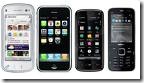
Nokia N97 Mini is real, launch date, specs and price leaked
Airtel and RIM today launched the BlackBerry Curve 8520, a new addition to the BlackBerry Curve series of smartphones.
According to a press release, the BlackBerry Curve 8520 introduces a touch-sensitive track-pad, which makes navigation easy. It is also the first BlackBerry smartphone to feature dedicated media keys, which are integrated along the top of the handset. In addition along with mobile solutions for email, messaging (IM, SMS, MMS) and social networking and a full-QWERTY keyboard, the BlackBerry Curve 8520 comes with multimedia features, applications to help users stay organized and productive, full HTML browsing and Wi-Fi support.
The BlackBerry Curve 8520 smartphone from Airtel measures 109 mm x 60 mm x 13.90 mm (L x W x D) and weighs 106 grams (including battery). Airtel customers can sms 'BB' to 543210 to register to purchase the BlackBerry Curve 8520 and to get more information about the plans offered with the smartphone.
The Blackberry Curve 8520 will be available across the country from August 7th and will be priced at Rs. 15,990.
Yet another good news about Win7. Microsoft has recently revealed that business customers can start ordering Windows 7 beginning September 7, slightly ahead of the general release of the OS on October 22.
Microsoft and its partners will take orders for Windows 7 from volume-licensing customers on that date, Microsoft Senior Vice President of Windows Bill Veghte revealed in a keynote Monday at the Microsoft Worldwide Partner Conference in New Orleans.
Microsoft also will offer a limited-time discount on the software to volume-licensing customers in the range of 15 percent to 35 percent, depending on the size of the order, he said.
Windows 7 was one of several products highlighted at Microsoft's annual partner meeting. In his keynote, Veghte stressed for partners the opportunity to provide services based on the OS, which will be available worldwide to both businesses and consumers on October 22, and will be released to manufacturing later this month.
Citing numbers from various research firms, including IDC, Veghte said that there are expected to be 77 million Windows 7 shipments by the end of 2010, and 59 percent of enterprises are expected to use Windows 7 in three years.
Microsoft will not be able to provide services and support for all of these customers, which is where partners come in. "We do not have the services capability to support that," he said.
However, another research firm believes that Windows 7 adoption may not be as widespread as some analysts and Microsoft think, despite the fact that many businesses skipped over Windows Vista and are still using the nearly eight-year-old OS, Windows XP.
A new survey conducted by ScriptLogic, the results of which were revealed Monday, found that nearly 60 percent of businesses don't currently plan to adopt Windows 7. The results were based on feedback from 1,000 IT administrators. ScriptLogic provides network administration software for Windows-based networks.
This article is adapted from PCWorld.in.
As we take our first look at the Nokia N97 it certainly comes off as an impressive device. Despite being only the second device by Nokia to sport a touch-screen and the first ever in its N-Series it is no less of a finished product. Like all phones of the N Series it is a class above the other Nokia phones, with a 3.5-inch screen, a 5MP camera, and a slide-out full QWERTY keyboard. Apart from the keyboard, the number of physical buttons are minimal, at just three.
The first thing that strikes you after you start up the device is a new widget-oriented home screen, where you can add / remove widgets to personalize the display. The widgets appear as six horizontal bars, of which the first is fixed as a time, date and profile display, and the other five can be moved around. With preloaded widgets for News, email, weather, Facebook, and so on it is easy to get relevant content at a glance.
The touch screen isn't all. The phone also comes with an inbuilt GPS, and a magnetic compass for a wonderful navigation experience along with Nokia Maps, which comes preloaded with data on Indian Cities. Also included is a proximity sensor which turns off the touch screen when you are making a call, and an accelerometer for auto-rotation of the screen. Storage comes in the form of 32GB memory which can be expanded by up to 16GB, yes, that's 48GB on a mobile! Enough for the phone to run out of digits to show how many pictures can be taken. WiFi support enables a faster internet experience and lower costs when at home. A TV-Out feature is also present, but even with a device which costs as much as this one, a TV-Out cable hasn't been provided.
While the phone doesn't support multi-touch, the touch features themselves are utilized quite well, and with a handy QWERTY keyboard around, available for use along with the touch screen, you wont miss much.
For a widget-centric design though, having just five predefined bars for widgets is a limitation. With Android's rather more powerful support for widgets, Nokia will need to do better in this department. The interface does have a few glitches, such as new menus items sometimes popping up out of place. These all are more of software issues, which we can expect Nokia to hopefully fix with firmware updates, which with their Firmware Over the Air feature, should be a trivial task.
The Nokia N97 doesn't take much getting used to, and most people will be able to immediately start working (or playing) with it, and even with the default suite of applications available in it you will be able to get enough done. As we get more familiar with the Nokia N97 we will take a deeper look at some it its key features and functionality.
This article is adapted from Thinkdigit.com
Intel's strategy to rename its chips and platforms has seen some opposition from chip enthusiasts, who say the new naming conventions are even more confusing.
The chip company this week announced it was making changes to the naming convention of Core processors, switching the derivatives attached to it. Tags like Core 2 Duo and Core 2 Quad will be replaced by names like Core i3, Core i5 and Core i7, depending on the type of PC and configuration.
Chips for entry-level desktops and laptops will carry the Core i3 brand, while chips for mid-level and high-end PCs will have Core i5 and Core i7 tags respectively. The Core i7 tag is already being used on Intel's Nehalem-based chips that go in high-end desktop PCs.
Intel said it will continue to use its Atom brand for low-power processors used in netbooks and smartphones. The company will also retain the Celeron and Pentium entry-level chips for mainstream laptops and desktops. The company said it would phase out usage of the popular Centrino brand to describe mobile laptop platforms by early next year.
"For PC purchasing, think in terms of good-better-best with Celeron being good, Pentium better, and the Intel Core family representing the best we have to offer," wrote Bill Calder, an Intel spokesman, in a blog entry. The change will make it easier for customers to differentiate and recognize brands in the future.
"The fact of the matter is, we have a complex structure with too many platform brands, product names, and product brands, and we've made things confusing for consumers and IT buyers in the process," Calder wrote.
But the glut of name changes has confused some users even more, who complained of the new names being incomplete. The changes would not fully reflect how the Core chip would perform, some people wrote in response to the blog entry.
"Too confusing. Make the names longer and more telling," wrote someone identified as Jonah, in a comment on the blog. Dismissing the new naming conventions as meaningless, multiple posters asked Intel to either retain the old names or change chip names to reflect the number of cores, clock speed and cache.
Calling the name changes "nonsense", another poster, John, wrote: "I buy a Core 2 Duo, I'm getting a 2 core processor made out of Core 2. Usually the clock speed is advertised as well. I buy a Core i5 who knows what the hell I'm getting except maybe Intel marketing."
In all the opposition, Intel found support from a few posters who said that the name changes could make it easier to distinguish chips.
"I can see how replacing the confusing mess of 'Core 2 Duo T6400' with 'Core i7' could make things easier for the typical consumer when browsing the laptops at Best Buy," wrote a poster, Colin.
Test adapted from pcworld.in
Genuine Validation is required for Windows Vista
A properly licensed copy of Windows Vista that has passed Microsoft Genuine validation is required to enable certain product features and to obtain non-security updates and product support from Microsoft.
More about Genuine Microsoft Software can be found on Windows Genuine Advantage FAQs page.
Copyright © 2008 gearShifts. This blog might contain information crucial to your system, please be aware before using any resources. Exclusive Portion of the contents may be reproduced with permission while rest others free. All Brands/Trademarks/Logos are registered by the respective companies. Should any right be infringed, it is totally unintentional. Send an e-mail or comment on any post and we shall promptly and gladly rectify it. All external sites open in a new browser. We don't endorse external sites and not responsible for their content. For broken links, site problems - please send Feedback.
Design by Free blogger template